


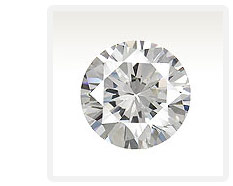
Diamond Information
- Diamonds are precious gemstones and symbolize love, luxury and everlasting commitment. Only 20% of the world's diamonds are of gemstone quality.
- Diamonds are the hardest natural material on Earth and the only gemstone made of a single element - carbon.
- All diamonds are ancient, ranging from 900 million to 3.2 billion years old!
- Diamonds are formed under extreme temperature and pressure. The liquid rock (magma) of active volcanoes carries deeply buried carbon to the surface, which hardens into vertical volcanic "pipes" of rock encasing diamond crystals.
- Diamonds can only be cut or polished using other diamonds. This doesn't mean a diamond is unbreakable. Its crystal structure has 'hard' and 'soft' directions and a hard whack in either direction can damage it.
- Experts mold rough diamonds by cutting and polishing them to unleash their brilliance and fire. Diamonds are graded on the Four Cs - color, clarity, cut and carat - which explains its rarity and resale value.
- A diamond's color is one of the most important factors in determining its market value and clear diamonds are the most expensive.
- Color is significant because it influences a diamond's fire. Diamonds create fire when light enters and is reflected into a sparkly color spectrum. A diamond's color acts as a filter and softens this sparkle.
- D-grade diamonds top of the scale. These diamonds are absolutely colorless and extremely rare.
- D-J color-grade diamonds are the most vibrant and fiery.
- G-J diamonds are perfect for shoppers on a budget. These diamonds are just as beautiful as pricier grades, and the savings can be significant.
- K-Z diamonds have faint or light hue of yellow or gray. Diamond color is more noticeable in platinum or white gold settings, so choose yellow gold settings to help these diamonds appear whiter.
- Z+ diamonds are called fancies and these diamonds are extraordinary bright blue, pink, yellow, green, and the rarest, red. Fancies are measured by their color intensity with darker diamonds being the most valuable.
- Almost all diamonds have flaws, called inclusions. Air bubbles, cracks and non-crystallized carbon are types of inclusions and they make every diamond unique.
- Diamonds are graded on the number, size and position of its internal and external inclusions.
- FL diamonds are flawless and IF diamonds are internally flawless. These clear diamonds are extremely rare and expensive.
- VVS1-S2 and VS1-S2 diamonds have "very, very slight" or "very slight" inclusions that can't be or typically can't be seen with the naked eye.
- Sl1 and S12 diamonds have slight inclusions that are visible when magnified or possibly with the naked eye, but cannot be seen through the crown of the diamond. Diamond lovers on a budget can enjoy brilliance for less if resell value is not a concern.
- Lastly, I1-I3 diamonds are graded as imperfect diamonds with visible inclusions.
- Cut refers to a diamond's dimensions, finish and light performance.
- Cut determines its reflective quality and is different than shape, the diamond's silhouette.
- Uncut, natural diamonds are called rough diamonds and look like beach glass. Diamonds become radiant and sparkling with expert cutting and polishing.
- Cutting can reduce diamond size by half but can quadruple its market value.
- Before cutting, experts use a formula to determine which proportions will reflect the most light. A diamond with the ideal width and depth will bounce white light off its surface and pavilion, creating fire or dispersion. Well-cut diamonds are valuable because of this colorful, flashing light.
- Diamonds that are cut too deep or shallow look dull and lose sparkle because light escapes through the sides or bottom.
- Symmetrical, well-polished facets (faces) also enhance brilliance by properly directing light and providing a smooth surface to produce fire. A round, brilliant diamond usually has 58 facets, 33 facets above the girdle and 25 below.
- The weight of a diamond is measured in carats. This term dates back to when diamonds were compared to carob tree seeds to determine their weight (1 seed = 1 carat). The actual weight of a carat is .2 grams.
- Today's diamonds are categorized according to points, whereas 1 carat = 100 points. Diamonds weighing less than 1 carat are called pointers. For example, a .50 ct diamond is a 50 pointer.
- Both weight and quality affect diamond price.
- Large diamonds are so rare, prices rise exponentially with carat weight. For instance, two 1-carat diamonds cost less than one 2-carat diamond of the same quality.
- More than 95% of all diamonds in jewelry are less than a carat.
- Diamonds with double the carat weight won't look twice as big because their tables don't double in size.
- Consider diamonds with lower color grades if you want to stay within a budget without sacrificing carat weight.
- Size is relative! If the diamond will be in a ring, consider setting and finger sizes. Small fingers will make the stone appear larger and vice versa.
- The word 'diamond' comes from the Greek word 'adamas' which means 'unconquerable.'
- In 1477, the Austrian Archduke Maximilian was the first to present his beloved with a diamond engagement ring as a symbol of his everlasting love and eternal commitment.
- Kings and warriors wore diamonds believing the gemstone's strength made its wearer invincible. Nobles like Cosimo de Medici from Florence and Henry II of France wore diamond rings in battle.
- Diamonds primarily came from India until mines were depleted in the 18th century. The feverish hunt to find a stable diamond source ended in South Africa's Cape Province in 1867. This forever changed the status of diamond from a rare stone for aristocrats to a luxury available to everyone.
- Today, diamonds symbolize romance, status, quality and durability. In the past, diamonds represented magic, healing, protection, poisoning and invulnerability.
- Renaissance mine owners circulated the myth that diamonds were poisonous to prevent workers from swallowing and smuggling them out of the mines.
- South Africa is the world's largest diamond provider. Zaire, Russia, Australia, Botswana, Angola, Namibia, Brazil, Ghana and China also mine diamonds.
- Australia's Lake Argyle is the world's largest diamond source by volume and has produced over 600 million carats of diamonds since its discovery in 1985.