| ||||
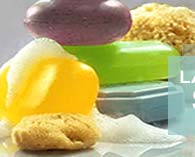
| A fragrant, handmade bar of soap is a simple indulgence that fosters
a feeling of relaxation and being pampered. Wrapping a bar with a band
of beautiful paper tied with a raffia bow makes for a truly unique
and luxurious, yet practical gift.
the legend
The emergence of soap remains a mystery, but one legend takes us
to an ancient site on Mount Sapo that was the setting for many animal
sacrifices in the early days of Rome. Over time, residual animal fat
and ash collected under the ceremonial altars. Fat and ash just happen
to be the key ingredients of soap. Supposedly one day a heavy rain
saturated the slopes of Mount Sapo, causing the fat and ash to mix
with the rain. The mixture flowed down the slopes to the banks of the
Tiber River where washerwomen were cleaning clothes. Inexplicably,
their clothing cleaned easier and more quickly once mixed with this
unknown substance, which we now know as soap.
overview
Soapmaking is a craft and profession dating back in time for thousands
of years. Today, mass produced soap is commonly available, but handcrafted
soap is experiencing a resurgence in popularity. Handmade soaps may
use more costly and exotic ingredients such as olive oil, coconut oil
or soothing herbs and extracts, resulting in soap that is unique and
luxurious.
types of soapmaking
melt and pour:
While other types of soap have been around for thousands of years,
melt and pour, also known as "glycerin" or "casting" soap, is a relative
newcomer. Soapmakers devised the concept of making transparent soap
in the 1800s, hoping that a clear soap would appeal to consumers as
more natural. This glycerin soap is also easy to work with. It's as
simple as melting down a premade block of soap, adding scents and color
and pouring it in a mold. The soap is ready for use in just an hour.
hand milled:
Hand milled soap, also known as "rebatching" soap, is made by taking
premade soap scraps and melting them into a liquid. This method renders
a completely natural bar of soap without the need to work with lye.
Hand milled soap only takes a few hours to make, but requires several
weeks to cure. It is more difficult to get consistent results with
this technique and the final product may appear lumpy.
cold process:
Basic soap is created when fats such as tallow, lard, coconut oil
or olive oil are blended with lye that has been dissolved in water.
As the two are stirred together, a chemical reaction, or saponification,
takes place, changing everything into soap, as well as the by-product
glycerin, a natural emollient. A well made bar of soap has no free
lye in it and is gentle and cleansing.
general instructions for melt and pour soap
It's easy to create your own handmade soaps. To get started, all
you need is a soap block, color and scent.
general instructions for hand milled soap
Hand milled soap, made from melted scraps of premade soap, can be
wonderfully creamy and airy.
general instructions for cold process
The basic process of making soap is fairly uncomplicated. However,
before getting started, you'll want to read up on the cold process
method. Use a recipe with precise weights and measurements to ensure
an accurate lye/water/oil ratio. Historically, basic soap was made
from animal fats such as tallow (fat from beef) and lard (fat from
pork). These days most handmade soap is made from plant-derived vegetable
oils such as olive, coconut, avocado and others. Fats are best for
cleaning and oils are best for suds, so a combination of fats and oils
makes the nicest soap.
Tip: Cold process soap can later be chopped up and remelted to make marvelous hand milled soaps. Ingredients you could add at to hand milled soaps: ground oatmeal, lanolin, vitamin E, juniper berry meal or avocado. try this!
tips and techniques
troubleshooting
safety tips
glossary
cold process: is a method of making batch soap adding only
refined ingredients which have been chemically balanced to each other.
A chemical reaction, or saponification, takes place over several days.
Glycerin, which is a natural by-product of this process, remains in
the finished soap.
essential oil: is derived from plants and is purported to have aromatheraputic benefits. flash point: is the temperature at which scent dissipates into the air and burns off. Scent has a flash point of about 120° F to 140° F, which is the temperature at which the scent burns off. Since soap melts at about 140° F, it is best to add scent just before pouring into molds, after letting the soap cool to under 120° F. fragrance oil: is made in the lab and can contain essential oils as a component part, but they are not entirely natural. glycerin: a by-product of making soap out of natural ingredients by the cold-process method. A natural emollient that acts as a skin moisturizer. hand milled: is made by taking scraps of premade soap and melting them into liquid. This method is useful for soapmakers who want a completely natural bar of soap, but who don't want to work with lye. lye: a form of potash, or sodium hydroxide. Also known as "caustic soda." melt and pour: also known as "glycerin" or "casting" soap. Glycerin soap is often translucent or transparent, but it can be made opaque with whiteners. saponification: the chemical reaction caused by the process of combining lye, vegetable or animal fats and water while the soap "cures" or rests. tracing: As lye and fat react chemically to form soap, the mixture "traces" or thickens and turns opaque. Test for tracing by dripping some soap onto the surface of the soap mixture in the stirring bowl. It should hold its shape on the surface. vegetable oils: each bring their unique qualities to soap. For example, coconut oil gives big, fluffy bubbles and olive oil gives fine, silky bubbles. When selecting oils, look for the "cold-pressed" version. Cold-pressed oils are 100% pure and contain more of the plant's natural ingredients, where refined oils contain petroleum residues from the solvents used in the extraction process. Cold-pressed oils are also better for your skin and the environment. about the author
Kelly Lenihan, currently residing in Malvern, PA originally hails
from Seattle, WA. As a Craftopia associate editor, Kelly specializes
in writing about art history as well as arts and crafts from around
the world. Kelly believes in using hands-on techniques to explore cultural
diversity and teach art appreciation.
|